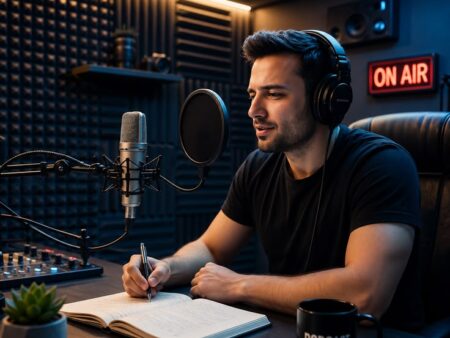

The virtual podcast is no longer a compromise. For the first three or four years of remote recording’s rise, it carried an implicit asterisk — real podcasts happen in studios, virtual ones happen when that isn’t possible. That framing is now obsolete, and continuing to treat it as accurate will cost you audience, guests, and competitive ground.
Today, 55% of Americans are monthly podcast consumers — the first time monthly consumption has reached the majority of adults in the US, according to RSS.com’s 2026 data. Globally, 584 million people tune in regularly. Virtual production — remote recording, distributed guest networks, cloud-based editing, multi-platform distribution — is not how shows compromise on quality. It is how the most strategically agile shows in every niche are scaling their output, expanding their guest rosters, and reaching audiences that geographically constrained in-studio models simply cannot access.
This guide is written for practitioners — people who are either running a virtual podcast now or seriously planning to. It covers the decisions that actually matter: platform selection, recording quality, guest strategy, distribution architecture, and the promotional infrastructure that determines whether your show grows or stagnates. No generic advice. No obvious tips. Just the operational specifics that the best virtual podcast teams have figured out through iteration.
What “Virtual” Actually Means in 2026 — And Why the Definition Matters
The term virtual podcast encompasses several distinct production models that are often conflated but require different tools, workflows, and strategic approaches. Getting clear on which model you are actually running — or planning to run — is the prerequisite for every other decision in this guide.
The remote interview podcast is the most common virtual format: host and guest in separate locations, connected via recording platform, producing a conversational episode that is edited and distributed as audio, video, or both. This is the category most people think of when they hear the term virtual podcast, and it is where the toolset — Riverside.fm, Squadcast, Zencastr — is most mature.
The virtual live event podcast is a newer and rapidly growing format: a live-streamed recording session with real-time audience participation, distributed afterward as a standard episode. Live-recorded episodes, virtual town-halls, and hybrid events are becoming mainstream show formats, with industry analysts from Content Allies citing them as one of the defining growth trends of the current year. The live component creates an event dynamic that dramatically increases pre-episode promotion opportunities and post-episode community engagement.
The distributed team podcast is less visible publicly but increasingly common at the organizational level: multiple hosts in multiple locations producing a show together, with no single geographic anchor. This model is particularly common in agency and B2B brand podcasting, where the hosts are often distributed across offices or time zones but want to maintain a consistent, co-hosted format.
Each of these virtual podcast models has different technical requirements, different audience expectations, and different strategic implications for growth and monetisation. The sections that follow address all three where relevant, but focus primarily on the remote interview and virtual live formats, which represent the largest share of shows and the greatest range of strategic choices.
The Recording Infrastructure Decision — Make It Once, Make It Right
The single most consequential early decision in building a virtual podcast is your recording infrastructure. This is not primarily a budget decision — it is a quality philosophy decision that will shape every episode you produce and every guest experience you create.
The central technical challenge of virtual podcast production is latency. When two people record in the same room, there is no delay — the conversation flows naturally because every vocal response is instantaneous. When two people record remotely, even a fraction of a second of latency creates micro-hesitations that trained listeners notice and that make conversations feel slightly off even when they cannot identify why. Solving this latency problem is the primary engineering challenge that separates good virtual podcast recording platforms from bad ones.
The platforms that solve it best in the current market do so by recording each participant locally — capturing a full-quality audio and video file on each person’s device simultaneously — rather than trying to transmit high-quality media over a live internet connection. The local recordings are then uploaded and synced in post-production, eliminating latency artifacts from the final product. Riverside.fm pioneered this approach in the podcast space and remains the industry standard; Squadcast and Zencastr offer comparable functionality with different UI preferences and pricing structures.
What to look for beyond local recording: browser-based access (guests should not have to download software), progressive backups that protect recordings if a connection drops mid-episode, video recording at 4K or higher for shows distributing video content, and a producer dashboard that allows a third party to monitor and manage the session without being heard on the recording. This last feature is particularly valuable for virtual podcast productions that involve a separate producer or engineer managing the technical elements while the host focuses on the conversation.
The equipment truth most guides won’t tell you: Your microphone matters more than your recording platform. A $100 dynamic microphone — the Shure MV7, the Audio-Technica ATR2100x — in a treated room will consistently outperform a $400 condenser microphone in an untreated space. Before investing in platform upgrades, invest in acoustic treatment. It is the highest-return hardware decision in virtual podcast production.
Guest Experience Is Your Competitive Differentiator
Here is something that most virtual podcast hosts underinvest in despite its direct impact on guest quality, episode quality, and word-of-mouth referrals: the guest experience. How a guest feels about the process of recording with you — from the initial outreach through the pre-show briefing, the recording session itself, and the post-recording follow-up — determines whether they recommend your show to their peers, whether they promote the episode enthusiastically to their audience, and whether they say yes if you invite them back.
The specific friction points in virtual podcast guest experience that most hosts fail to address include: unclear technical instructions that leave guests anxious about setup, no pre-show test session to identify and resolve audio or video issues before the recording starts, lack of context about the show’s audience and the host’s goals for the episode, and absent follow-up after the episode airs that leaves guests feeling like they contributed to a show that promptly forgot about them.
The shows with the best guest rosters — the ones that consistently attract high-profile, knowledgeable guests who bring genuine depth to every conversation — have almost universally built deliberate guest experience systems. They send a comprehensive pre-show guide that answers every technical question a first-time remote podcast guest might have. They schedule a 10-minute technical check before every recording. They brief guests specifically on the audience and the episode goals so the conversation is focused from the first minute. And they send a personal follow-up when the episode airs that makes the guest feel genuinely valued.
In the virtual podcast space, guest experience is also your most efficient marketing channel. A guest who had an exceptional experience with your production process will tell other potential guests — and that word-of-mouth referral network is the mechanism through which the best shows continuously attract higher-caliber guests without proportionally increasing their outreach effort.
Distribution Architecture for Virtual Shows — Think Platform-First, Not Platform-Agnostic
The dominant distribution advice for virtual podcast producers over the past several years has been some variation of “be everywhere” — distribute to Apple Podcasts, Spotify, YouTube, Amazon Music, and every other directory simultaneously, maximizing potential discovery across all platforms. That advice was reasonable when the podcast ecosystem was younger and audience habits less differentiated. In the current environment, it is strategically incomplete.
The platforms that drive meaningful discovery in 2026 have developed sufficiently distinct recommendation algorithms, audience demographics, and content preferences that a thoughtful virtual podcast distribution strategy needs to be platform-aware rather than platform-agnostic. Publishing the same content in the same format across all platforms and hoping the algorithms do the rest is not a distribution strategy — it is content disposal.
YouTube has become the world’s largest video podcast platform, with users streaming over 700 million hours of video podcast content on television screens alone in a single month, according to Venturemedia. For a virtual podcast that includes a video component, YouTube is not just one distribution channel — it is the primary discovery engine that deserves dedicated optimization: keyword-rich titles, custom thumbnails designed for television display, timestamped chapters, and a description architecture that targets the search queries your audience is actually using.
Spotify’s listener base skews younger and more music-adjacent than Apple’s, and its recommendation system is more algorithm-driven and less dependent on the kind of editorial curation that historically shaped Apple Podcasts discovery. For shows targeting under-40 audiences, Spotify’s recommendation engine often drives more organic discovery than any other platform. For shows targeting older professional audiences — the kind most common in agency and B2B brand podcasting — Apple Podcasts’ more editorial, curation-friendly environment frequently produces better results.
The practical implication for virtual podcast producers: distribute everywhere as a baseline, but identify the one or two platforms where your specific audience is most concentrated and invest in platform-specific optimization for those. Generic distribution plus targeted optimization outperforms pure distribution breadth at every stage of show growth.
The Virtual Podcast Guest Booking Challenge — And How to Solve It
One of the structural advantages of the virtual podcast format is the geographic flexibility it creates for guest booking — you are not limited to guests who can physically travel to your recording location. One of the structural challenges of the same format is that this flexibility is available to every other show competing for the same guests, which means the booking environment for high-value guests has become significantly more competitive.
The most sought-after guests in any professional niche receive multiple podcast booking requests every week. Most of those requests are generic, poorly targeted, and easy to decline. The requests that consistently convert are the ones that demonstrate specific knowledge of the guest’s work, articulate clearly why their specific expertise serves the show’s specific audience, and make the logistics of participation as frictionless as possible. This is not complicated — but it requires deliberate effort that most virtual podcast hosts are unwilling or unable to invest consistently.
The agencies and brands that run the most successful virtual podcast shows have typically made one of two choices when it comes to guest booking: either they have built a dedicated internal function with a researcher, an outreach specialist, and a scheduler — or they have outsourced the function to a specialist podcast booking service that brings existing host relationships, proven pitch frameworks, and the volume of outreach that makes consistent high-quality bookings sustainable.
The economics of outsourcing guest booking are straightforward. The time required to research a target guest list, draft personalized pitches, follow up systematically, manage scheduling, and brief guests for each episode amounts to 10 to 15 hours per episode for most shows. For a host or an agency that values their time at a professional rate, that time cost exceeds the cost of professional booking services — and the booking services typically produce better results because their relationships and processes are purpose-built for the task.
For a detailed look at how one of the most creatively ambitious podcast agencies approaches the combination of production excellence and strategic guest booking that defines a high-performing virtual podcast operation, our review of the Earworm Podcast Agency’s model and methodology breaks down exactly what distinguishes full-service podcast partners from production-only vendors — and what to look for when evaluating your options.
Video and the Virtual Podcast — A Decision Framework
Eighty-four percent of podcast consumers engage with video podcasts in some way, according to 2026 Podbean data. Ninety percent of Gen Z podcast consumers engage with video podcast content. Those numbers make a compelling case for adding video to any virtual podcast — but the case for adding video is not unconditional, and the decision deserves more nuance than most guides provide.
The real question is not whether to record video — it is whether you are prepared to use video strategically rather than superficially. A virtual podcast that records video but publishes it without optimization, without thumbnails, without chapters, without a clip strategy, and without platform-specific distribution is not running a video podcast strategy. It is producing a video asset that nobody will discover.
The workflow requirements for effective video integration in a virtual podcast are specific and non-trivial. You need a recording platform that captures high-quality local video from each participant. You need a consistent visual environment — branded backgrounds, good lighting, a professional camera or high-quality webcam — for every participant, which requires guest briefing and sometimes direct support for guests whose home setups are not camera-ready. You need an editing workflow that can handle multi-track video synchronized with multi-track audio. And you need a thumbnail creation and clip extraction process that turns raw episode footage into platform-optimized distribution assets.
For shows that build this infrastructure properly, the payoff is significant. Deloitte’s research confirms that 44% of video podcast viewers never multitask while watching — compared to 29% of audio-only listeners — meaning video audiences are more attentive, more engaged, and more valuable to any brand trying to build genuine connection through their virtual podcast.
Growth Mechanics — What Actually Moves the Needle
The honest answer to the question of what drives virtual podcast growth is that audience building is slow, nonlinear, and heavily dependent on factors outside any individual host’s control — until it isn’t. The shows that break through from modest listenership to substantial audiences almost universally share a set of growth mechanics that are identifiable in retrospect, even when they were not systematically planned.
Cross-promotion through guest audiences remains the single highest-leverage growth mechanism for virtual podcast shows at every stage. Every guest you book is a temporary window into their audience — people who already trust that guest’s judgment and are predisposed to explore content they recommend. Maximizing the promotional output from each guest relationship — coordinating episode promotion timing, providing shareable assets, making it easy for guests to direct their audience to the episode — is the highest-ROI growth investment most shows can make.
SEO-driven discovery through episode show notes and transcripts is the growth mechanism most consistently underutilized by virtual podcast producers. Every episode is an opportunity to rank for the specific questions your target audience is searching — but only if the show notes are written as genuine content rather than a brief summary and a list of links. A well-written, keyword-informed show notes page for a high-value episode can drive organic search traffic to that episode indefinitely, long after the promotional push from the episode’s launch week has dissipated.
Community-driven growth — building a deliberate listener community around your virtual podcast through a private group, a Discord server, or a regular newsletter — transforms passive listeners into active advocates who recruit new listeners from their own networks. Shows that have built active communities consistently report higher review generation, more consistent listenership, and stronger word-of-mouth growth than shows with equivalent download numbers but no community infrastructure.
For agency owners and brand leaders looking at the specific growth dynamics of shows targeting professional audiences — and how the most successful shows in the agency space have built the kind of engaged listener communities that drive sustainable growth — our in-depth look at the Agency Excellence Podcast’s audience development approach covers the specific strategies that have made this show one of the most respected in its category.
The Monetisation Reality Check
Most virtual podcast producers who are thinking about monetisation are thinking about advertising. That is understandable — advertising is the most visible podcast revenue model and the one most commonly discussed. It is also the last model you should build your monetisation strategy around if you are running a show with a targeted professional audience and genuine expertise behind it.
Here is the arithmetic that changes the calculation. A virtual podcast with 5,000 monthly downloads monetised through mid-roll advertising at a $25 CPM generates roughly $125 per episode — a meaningful but modest figure. The same show with 500 highly engaged professional listeners who subscribe to a premium tier at $15 per month generates $7,500 per month. The subscriber revenue is 60 times higher from 10 times fewer listeners — because the value per listener relationship is dramatically higher when it is based on direct investment rather than passive exposure.
This is not an argument against advertising. For shows with large, broad audiences, advertising revenue can be substantial and should be pursued. It is an argument for sequencing your monetisation strategy correctly — building audience trust and engagement first, then introducing direct revenue models that convert on the strength of genuine listener value, and finally layering advertising on top as the audience scale warrants it.
The virtual podcast format is particularly well-suited to direct monetisation because the remote production model scales with lower marginal cost than in-studio production. Adding subscriber-only bonus episodes, live Q&A sessions, or extended cuts requires no incremental studio investment — just the same recording infrastructure you are already using for your main feed. That scalability makes the economics of premium tiers especially favorable for virtual shows.
Choosing the Right Agency Partner for Your Virtual Show
At some point in the growth of most serious virtual podcast operations — typically when the show has demonstrated clear audience demand and the host’s time is too valuable to spend on production logistics — the question of working with a podcast agency becomes relevant. The decision is not simply about offloading work. It is about choosing a partner whose capabilities align with the specific stage and ambitions of your show.
A production-only agency handles editing, show notes, and distribution. That is valuable but incomplete for shows that also need guest booking, promotional strategy, PR outreach, and audience development support. A full-service podcast agency handles the entire production and growth stack — which is what most serious virtual podcast operations need once they reach the stage where growth is the primary focus rather than just production quality.
The distinction matters because the mistakes made when choosing a partial-service provider — assuming they will also handle functions they are not designed for — are expensive and disruptive to fix. Be explicit about what you need before you engage any agency partner, and evaluate candidates against the full scope of your requirements rather than just the production capabilities that are easiest to demonstrate in a sales conversation.
For virtual podcast shows that are ready to accelerate growth through strategic guest placement, PR, and targeted outreach to the right audiences — rather than relying solely on organic discovery — PodcastCola is a leading US-based podcast booking and PR agency that has helped numerous shows build the kind of consistent, high-quality guest rosters and promotional infrastructure that transforms a good virtual show into a genuinely influential one. Their approach combines the relationship network and outreach expertise of a specialist booking service with the strategic perspective of a full-service podcast PR partner.
The Compounding Logic of Virtual Podcast Investment
Everything in this guide points toward a single underlying truth about the virtual podcast format: the returns are front-loaded in work and back-loaded in results, which means most people who start shows quit before the compounding begins.
The first ten episodes of any virtual podcast feel thankless. Small audiences, uncertain production quality, guests who are hard to book, promotional efforts that seem to go nowhere. This is not a sign that the show is failing — it is the normal experience of a show in its audience-building phase. The shows that persist through this phase and continue to improve their production, their guest quality, and their distribution consistency are the ones that eventually experience the nonlinear growth jumps that look miraculous from the outside but are entirely predictable from the inside.
The compounding dynamic of a virtual podcast is driven by three reinforcing loops. Better guests lead to better episodes, which lead to larger audiences, which attract better guests. Larger audiences drive more reviews, which improve platform discoverability, which attract larger audiences. More consistent content and community engagement builds listener trust, which converts to subscriptions, referrals, and commercial relationships that fund further investment in quality. Each loop reinforces the others, and once all three are turning simultaneously, the growth trajectory changes qualitatively.
Getting those loops started requires patience, quality, and consistency — and in most cases, the right support at the right stage of the show’s development. If you are at the point where your virtual podcast has demonstrated genuine audience demand and you are ready to invest in the professional infrastructure that accelerates the compounding, the PodcastCola team is worth speaking with about what a targeted growth strategy looks like for your specific show, audience, and goals.